In my six years of sailing the seven seas, I’ve met all kinds of new friends and interesting folks. But I’ve also met the problem passengers: the rude ones, the greedy ones, and the always-late ones.
Don’t be like them. Here are five cruising pet peeves and no-nos to avoid, so you can make sure you’re a crew favorite:
It’s every cruiser’s worst nightmare: to find yourself gazing up as your cruise ship sails off into the sunset…without you. Cruise lines run a tight ship, literally — and if you’re late, they will not wait. If you find yourself in this situation, it will be down to you to cough up the cash and pay for a flight to the next port of call. To avoid this, make sure you’re always on the local time. Otherwise, you could end up like British couple the Pratts, who arrived back at their Danube port only to realize their watches weren’t on central European time. It was noon in England, not Austria.
Much like Rebel Wilson, if my family went to a buffet growing up, we always took some home with us. No need to do this on a cruise ship. The buffet is open for much of the day, and sometimes for twenty-four hours — in fact, thinking back to my first cruise holiday as a young teen, I remember feeling like it was Christmas upon discovering this. If you’re really desperate to eat in your cabin, some vessels will even allow you to order directly to your stateroom free of charge.
in steward makes your bed and leaves an artistic animal-shaped towel creation on top of your duvet, thank them. One of the biggest insults to staff is stiffing them on gratuity. These tips contribute directly towards their salaries; removing gratuity from your fare will only mean the crew is doing the same work for less money.
Planning a trip across or around Europe? Don’t forget to schedule some downtime! These six locations scattered around the continent are ideal for relaxing amidst your busy itinerary. Take a break in Budapest, or get some much-needed R&R in Andorra. The choice is yours!
The Széchenyi Medicinal Bath in Hungary
These baths in Budapest are known worldwide for their medicinal qualities due to the chemical composition of their waters. The complex’s indoor and outdoor heated pools allow for year-round bathing, whatever the weather. By day, you can relax and enjoy their healing powers. By night, get ready for the craziest outdoor party in Europe as the baths turn into a ‘Sparty’, with bars, music and a whirlpool.
The Blue Lagoon in Iceland
With bright blue, geothermal waters which naturally soothe your skin, there is no better way to relax than by plunging into the Blue Lagoon. The mud from the bed of the lagoon can even be used as a purifying face mask. For the best experience, stay at one of the nearby hotels where you can benefit from spa treatments and excellent food.
Saturnia Hot Springs in Italy
These incredibly beautiful hot springs are tucked away in the Tuscan countryside. Find yourself in awe, not only at the cascading warm waters, but also at the fact that they are completely free to enjoy every day of the year. Bring a picnic and set up camp on the rocks beside the springs, taking regular dips in between sunbathing.
Pamukkale-Hierapolis Thermal Pools in Turkey
Pamukkale is a small town hidden in western Turkey, and is neighboured by a small Roman spa city called Hierapolis. Although not technically in continental Europe, Pamukkale deserves a mention thanks to its unique topography. Due to its naturally mineral-rich waters, this area is dotted with several hot springs and thermal baths which create a truly idyllic landscape. Bathe in the crystal clear waters of the Antique Pool, located in Hierapolis, and watch water cascade down the white travertine terraces in Pamukkale.
Pamukkale-Hierapolis Thermal Pools in Turkey
Pamukkale is a small town hidden in western Turkey, and is neighboured by a small Roman spa city called Hierapolis. Although not technically in continental Europe, Pamukkale deserves a mention thanks to its unique topography. Due to its naturally mineral-rich waters, this area is dotted with several hot springs and thermal baths which create a truly idyllic landscape. Bathe in the crystal clear waters of the Antique Pool, located in Hierapolis, and watch water cascade down the white travertine terraces in Pamukkale.
Victorian Turkish Baths in England
Harrogate is a small English spa town North Yorkshire, known famously for its mineral springs discovered back in the 16th century. The Turkish Baths offer the chance to relax in these medicinal waters, rich in sulphur and other minerals, making this the perfect English holiday destination.
Caldea in Andorra
Caldea is a huge thermal spa complex in the Andorran Pyrenees. The baths boast four different spas with jacuzzis, waterfalls and massage jets allowing for the ultimate relaxation experience. The area is home to some of the hottest thermal spring waters in Europe, which makes Caldea the perfect place to relax and warm up during ski season.
Hilton will celebrate its 100th anniversary on May 31 and the company, which calls itself “the first global hospitality company,” marked the occasion with an event in New York where it looked to the past, present and future of the brand.
Today, Hilton has 17 brands, more than 5,600 properties and more than 2,300 properties in its pipeline; one of every five hotels opening in the world is a Hilton. The company started in 1919 when Conrad Hilton bought a small hotel in Cisco, Texas. The first with the Hilton name came along in 1925 (the Hilton Dallas) and by the 1950s, Hilton became the first coast-to-coast hotel chain in the U.S.
It also opened the first hotel outside the continental U.S, the Hilton Caribe in Puerto Rico and soon opened the Hilton Istanbul, the first modern hotel built from the ground up in Europe after WWII. Conrad Hilton became the first hotelier to appear on the cover of Time magazine.
Hilton has had many lodging firsts, according to Karla Starr, author of “The Hilton Effect,” a history of the company: room service, televisions in rooms and lobby shopping among them. She said Conrad Hilton was the first to recognize business travelers as a distinct market and targeted them initially.
In addition, Conrad Hilton invested heavily in air conditioning in the 1950s, creating the possibility of year-round convention business, said Dr. Mark Young, archivist and historian for Hilton College of Hotel and Restaurant Management at the University of Houston.
Pablo Torres, general manager of the Caribe Hilton, which was heavily damaged by Hurricane Maria two years ago, said the property will reopen May 15 after extensive renovations to rooms, public space and the beach. That property was the site where the piña colada was invented.
Discussing Hilton today Mark Weinstein, senior vice president and global head of customer engagement, said Hilton’s Honors loyalty program now has 85 million members. Hilton Honors now offers a “slider” option where travelers can choose any combination of money or points to redeem awards and that the option to choose experiences like concerts is growing rapidly.
Tripp McLaughlin, global head of the newest brand, Motto, said it is a micro-hotel concept that offers smaller but highly designed rooms with an active lobby and extensive local partnerships.
Looking ahead, Hilton aims to shrink its environmental footprint through its Travel With Purpose program, according to Katie Fallon, executive vice president and global head of corporate affairs. Calling itself the first major hotel chain to institute science-based carbon emission targets, the company has the goal of cutting its environmental footprint in half and doubling its social impact by 2020.
Ian Carter, president of global development, architecture, design and construction, said more than half of the company’s pipeline is overseas with a special focus on the Middle East, Africa, China and all-inclusive hotels in the Caribbean and northern South America.
Noelle Eder, chief information and digital officer, said the Connected Room continues to be rolled out, enabling guests to use an app to control the heating and cooling in their rooms, entertainment on their devices, lights and more. “And we’re just getting started,” said Eder.
A new feature, said Eder, is called “Explore the Neighborhood” and offers suggestions from hotel staff about what to do in the destination. The mission, said Eder, is to focus on flexibility and speed to enhance the guest experience through technology.
HONOLULU — Last year, much of Hawaii was shocked to learn a Chicago restaurant chain owner had trademarked the name “Aloha Poke” and wrote to cubed fish shops around the country demanding that they stop using the Hawaiian language moniker for their own eateries. The cease-and-desist letters targeted a downtown Honolulu restaurant and a Native Hawaiian-operated restaurant in Anchorage, among others.
Now, Hawaii lawmakers are considering adopting a resolution calling for the creation of legal protections for Native Hawaiian cultural intellectual property. The effort predates Aloha Poke, but that episode is lending a sense of urgency to a long-festering concern not unfamiliar to native cultures in other parts of the world.
“I was frustrated at the audacity of people from outside of our community using these legal mechanisms to basically bully people from our local community out of utilizing symbols and words that are important to our culture,” said state Sen. Jarrett Keohokalole, a Native Hawaiian representing Kaneohe and Heeia.
The resolution calls on state agencies and Native Hawaiian organizations to form a task force to develop a legal system to “recognize and protect” Native Hawaiian cultural intellectual property and traditional cultural expressions. It also seeks protections for genetic resources, such as taro, a traditional crop that legend says is an ancestor of the Hawaiian people and that scientists have tried to genetically engineer in the past.
The task force would be commissioned to submit its recommendations and any proposed legislation to lawmakers in three years.
The resolution has passed House and Senate committees. The full Senate is scheduled to vote on it Monday.
The Aloha Poke incident echoes past disputes, like when a non-Hawaiian photographer claimed copyright over an image of a woman dancing hula and Disney copyrighted a modified version of a Hawaiian chant used in a movie.
Chicago’s Aloha Poke Co. chose as its battleground the word “aloha” — a term meaning love, compassion, kindness as well as hello and goodbye. It’s a term central to how Native Hawaiians treat others and how many in Hawaii — Native Hawaiian or not — try to live.
“It’s traumatic when things like this happen to us — when people try to take, modify or steal what’s been in our people’s world view for generations,” said Healani Sonoda-Pale, chairwoman of the Ka Lahui Hawaii political action committee, who testified in support of the resolution.
Aloha Poke CEO Chris Birkinshaw didn’t return messages seeking comment left at his West Madison store in Chicago and on the company’s website. The company has stores in Illinois, Wisconsin, Minnesota, Florida and Washington, D.C.
Aloha Poke Shop in Honolulu initially ignored the Chicago company’s letter, said co-founder Jeff Sampson. When the issue burst into the news, he and his partners had an attorney write their Chicago counterpart saying they wouldn’t change their name. They explained there would be no confusion between their businesses because they operated far from the mainland company’s stores.
But Tasha Kahele, who is Native Hawaiian, has spent nearly $10,000 so far changing her Anchorage store’s name to Lei’s Poke Stop after receiving one of the letters.
Native Hawaiian experts note there’s a cultural clash underlying much of this. Modern European-based traditions use trademarks, copyright and patents to create economic incentives and rewards for creating knowledge and culture. Indigenous culture, on the other hand, is often passed on through generations and held collectively.
“They’re never going to sit nicely together in a box,” said Kuhio Lewis, the CEO of the Council for Native Hawaiian Advancement.
It will be difficult to determine who would decide who can use Native Hawaiian culture and who would be able to use it. Limits may violate the First Amendment of the U.S. Constitution. The task force will have to explore who can do what, Lewis said.
“At the least, they need to have some cultural sensitivity about how it’s used. And they need to know you can’t be telling Native Hawaiian businesses they can’t use their own language,” Lewis said.
The resolution points to potential models in New Zealand and Alaska, which both created signifiers that indigenous people may place on their art as a mark of authenticity.
Marie Texter of Anchorage said her late father Andy Makar — who drew, made carvings from tusks, cottonwood and horns, and sewed animal skins — was a strong believer in the Silver Hand seal for Alaska Natives.
“He said this is a great program because so many times the Native artwork gets commercialized or used by someone else,” she said.
He had to fill out proof of his Indian blood — he was mostly Yup’ik but his mother was Athabascan — to apply.
But Rosita Worl, president of Juneau-based Sealaska Heritage Institute, said not all Alaska Native artists apply for or use the emblem. Nor does the program deter the sale of bogus Native art made overseas, she said. It also lacks enforcement and publicity, she said.
Charles E. Colman, a University of Hawaii law professor, said such programs hold up under federal law because they don’t prohibit people from making work that resembles indigenous art. They merely won’t allow people to say their work is produced by an indigenous person if it’s not.
Colman believes the Aloha Poke situation, on the other hand, could be addressed within existing trademark law.
He believes the Chicago company’s trademark could be cancelled if challenged because it’s not so well-known that its name has developed a secondary meaning the way the words in the retailer name “Best Buy” have, for example.
“You can’t just register a descriptive phrase unless you’ve achieved a certain amount of public recognition,” he said.
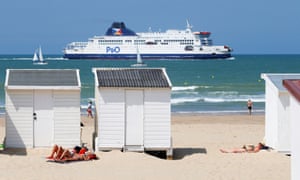
‘The bow doors have opened’ as Dover to Calais bookings rise by more than 55%
Ferry services to Europe have reported a ticket sales rise of more than 50% as holidaymakers book summer breaks after Brexit was delayed.
Holidaymakers had been warned of potential difficulties travelling to the continent, especially by car and ferry, in the event of a no-deal Brexit. The decision to put Britain’s date of departure from the European Union back from 29 March to at least the end of May, and possibly 31 October, has unleashed a wave of ticket sales.
Bookings on the Dover-Calais route have increased 55% on last year over the past seven days. Overall, there has been a 52% uplift in ticket sales across the 13 ferry routes between the UK and other European countries.
Direct Ferries, which sells tickets across Channel ferry routes and operators, said there had been triple-digit percentage growth in bookings on some longer channel crossings, such as those linking the south of England with Brittany and Spain.
Millions of Norwegians are officially off for Norway’s long five-day Easter holiday weekend that began on Thursday, with more than half of them out travelling within the country or heading abroad. There’s little sign they’re sacrificing holiday travel out of concern for the climate or the carbon emissions that flying and driving can generate.
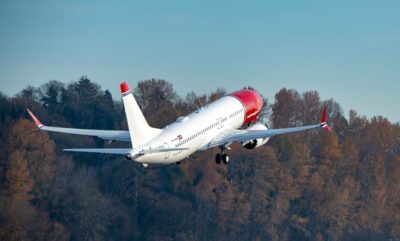
Norwegian Air’s carbon emissions rose 51 percent between 2013 and 2018, largely because of its route expansion. The airline itself claims that emissions per passenger-kilometer have declined 30 percent since 2008 because of more fuel-efficient aircraft. PHOTO: Norwegian Air
Oslo’s main airport at Gardermoen reported more huge numbers of people passing through last weekend, as many seized the opportunity to get 10 days off in a row for the price of just three vacation days from work (Monday, Tuesday and Wednesday). A new survey conducted by research firm Kantar/TNS for the national tourism employers’ organization NHO Reiseliv shows that nearly 20 percent of those out traveling flew to other countries in Europe or beyond.
Others hit the road, loading up the car and driving to mountain cabins for spring skiing, opening up holiday homes along the coast, or visiting family and friends. Fully 78 percent of those reporting that they’d leave home during the Easter holidays planned to travel to another location in Norway.
“The vast majority of Norwegians still view Easter holidays within Norway as their top choice,” Kristin Krohn Devold, a former defense minister who now heads NHO Reiseliv, told news bureau NTB.
‘The new coal’
With 55 percent of those questioned replying that they’d leave home during Easter, the travel bug continues to bite, and that worries climate activists. Oslo newspaper Dagsavisen recently reported how another new study shows that an airline now ranks as one of the 10 largest sources of carbon emissions in Europe.
The dubious distinction went to Ryanair, according to the study conducted by the organization Transport & Environment (T&E). Norway’s chapter of Friends of the Earth, Naturvernforbundet, is among the members of T&E and was sounding alarms before the Easter holidays even began.
“When it comes to the climate, Ryanair is the new coal,” claimed Andrew Murphy, aviation chief at T&E. The organization used EU data showing emissions development for around 14,000 companies in various sectors. The nine biggest generators of carbon emissions were coal-driven power plants, topped by Belchatow of Poland, which released 38 million tons of carbon last year. The 10th spot on the list was Ryanair, whose flights around Europe released 9.9 million tons of CO2 in 2018.
Route expansion to blame
Norway’s two biggest airlines, Norwegian Air and SAS, released far less, at 2.8 million- and 2.5 million tons respectively, “but that’s more than what all the diesel vehicles in Norway released in 2017,” Holger Schlaupitz of Naturvernforbund told Dagsavisen. Norwegian’s carbon emissions growth from 2013 to 2018 hit 51 percent, much higher than SAS’ 6 percent and reflecting Norwegian’s major route expansion. Ryanair’s growth was 49 percent, while carbon emissions for airlines flying within Europe rose 26 percent on average.
While carbons emissions are falling in most other sectors including coal, they’re rising within the aviation sector because of the strong growth in airline traffic. Schlaupitz notes that Norwegians have contributed to that growth with 52 million passengers passing through state airport agency Avinor’s airports last year. That’s more than double the number in 1993.
“It’s clear that it’s too cheap for airline traffic to pollute, and that the prices for jet fuel are relatively low,” Schlaupitz claimed. He has no faith that either more fuel-efficient aircraft, electric aircraft or more use of biofuels will cut emissions from airline traffic, as long as it continues to grow.
Political approval for more airline traffic growth
All indications are that it will. Avinor actively seeks new airline routes from its airports and offers incentives to the airlines to get them. Avinor also remains keen to build a third runway at OSL Gardermoen. A majority in Parliament (formed by the government parties and the Labour Party) voted down a measure proposed by other more-climate-oriented parties in opposition to block it.
The airlines, meanwhile, defend their emissions growth by contending that their aircraft have reduced emissions per passenger-kilometer. Norwegian Air claims its emissions per passenger-kilometer have declined by 30 percent since 2008 because of major investment in new, more emissions-friendly aircraft.
“Last year Norwegian paid more than NOK 1.3 billion in so-called ‘environmental fees’ to the EU’s quota system, CO2 taxes on domestic routes and the airline seat tax in Norway and Sweden,” Norwegian Air spokesman Lasse Sandaker-Nielsen told Dagsavisen. He added that Norwegian Air continues to call for a CO2 fund that could be used to promote environmental goals.
The birds know it’s morning before you do. A single sweet note breaks the velvety silence and is quickly joined by a chorus of birdsong. Grape leaves rustle as some small creature wanders through the vineyard in search of breakfast. The inky darkness lightens to smoky grey and then brightens to gold as sunlight spills molten over the bluffs across the valley.
It’s another perfect day in wine country. And there are few places better to greet it than right here on the Golden Mile Bench.
Watching the sun rise from the guest villas at Hester Creek Estate Winery.JOANNE SASVARI
The bench is a steep, sandy, gravelly, loamy slope just south of Oliver, pop. 5,000, the little town known as the Wine Capital of Canada. It’s British Columbia’s first sub-geographical indication, a unique place within wine country that just happens to be the perfect spot to grow lush Chardonnay and elegant Merlot. Some of B.C.’s greatest producers can be found here doing just that, among them Culmina Family Estate Winery, CheckMate Artisanal Winery, Tinhorn Creek Vineyards, Fairview Cellars, Road 13 Vineyards and Hester Creek Estate Winery.
Days move lazily here, broken by delicious moments. Hop in the car—or on your bike, though it’s easier to load cases of wine in your car—and meander along the numbered country roads that lead to Black Sage Road across the valley, where wineries produce peppery Syrahs and voluptuous Viognier. Head north, past the massive boulder known as McIntyre Bluff, and you’ll bump into Penticton’s twin sandy beaches. Head south, and you’ll find yourself in the desert surrounding Osoyoos and, just a few metres further, the U.S. border. But here, between the Golden Mile and Black Sage benches, it’s all rolling hills striped with vineyards, and hidden in their folds, people who want to give you lovely things to eat and drink.
You’ll need a central location to start from, a home base. A guest house like the Tuscan-style ones at Hester Creek Estate Winery will do quite nicely. They have kitchenettes, comfy furniture and, perched as they are high above the winery, patios with sweeping views across vineyards and valley. You can make yourself right at home without having to worry about pesky details like bringing in the harvest.
Hester Creek winemaker Rob Summers with a handful of grapes.JOANNE SASVARI
The winery itself is historic in this valley. Fifty years ago, back when everyone else in the Okanagan was still planting hybrid varieties like Vidal and Marechal Foch, an Italian immigrant named Joe Busnardo planted the first vitis vinifera here, including the Trebbiano vines that still produce a bright, crisp white wine each spring. The wines he made from these noble grapes were, by all accounts, terrible, but he proved that they would thrive here.
In the 1980s, Busnardo opened Divino Estate Winery on the site, and when he sold it in 1996, the new owners named it for the creek that runs along the south side of the property. In 2004, Prince George businessman Curt Garland bought the winery and hired Rob Summers, a veteran winemaker from Niagara, to produce its wines, which, please note, are no longer terrible. Far from it. The Cabernet Franc is elegant yet approachable, all black fruit and violets, and the Bordeaux blend known as The Judge is a powerful combination of juicy fruit and supple tannins.
Grab a bottle (or two) from the wine shop and some cheese and charcuterie from Oliver Eats, the new gourmet deli from local chef Derek Uhlemann. Or pick up some authentic tacos al pastor from El Sabor De Marina, the turquoise-blue Mexican food stand just outside town, if you can wait till you get home to dive into their savoury depths. Or, if you’re feeling adventuresome, head out to one of the great restaurants in the neighbourhood, which, happily, are all located at wineries: Miradoro at Tinhorn Creek Vineyards, The Sonora Room at Burrowing Owl Estate Winery, Masala Bistro at Kismet Estate Winery, or Terrafina right here, just down the hill at Hester Creek.
Chef Bernard Casavant of RauDZ Creative Concepts serves an al fresco lunch on the patio at Terrafina Restaurant.JOANNE SASVARI
About a year ago, chef Rod Butters’ RauDZ Creative Concepts took over the Tuscan-themed restaurant, and while chef de cuisine James Hanna still takes inspiration from the Mediterranean, Terrafina’s new menu is proudly local and seasonal. It abounds in pastas, risottos and pizzas made with fresh local produce. Though truth be told, you could simply order the fully customizable boards that come loaded with marinated veg, cured meats and cheeses and be perfectly happy sipping wine at a patio table and watching the glow from the setting sun dance across the vines.
From Terrafina, it’s just a short stroll under the stars back to your guest villa. The night falls gently here, cool and fragrant, cattle lowing softly in the hills, birds trilling goodnight. Rest well in your suite, happy in the knowledge that tomorrow you can do it all again.
If you go
Getting there:
Both Air Canada and WestJet fly into Penticton airport. From there, it’s a 40-minute drive south to Oliver. However, if you plan to bring back wine, you might prefer the scenic five-hour drive from Vancouver along Highway 3.
While you’re in the south Okanagan, the hop-on, hop-off OK Wine Shuttle is a safe way to get to most of the wineries.
Staying there:
The new Coast Oliver Hotel is central, convenient and pet-and child-friendly.
For a more luxurious stay, head to the Tuscan-style Hester Creek Estate Winery Guest Villas—six well-appointed suites with a gourmet breakfast included—but be sure to book well in advance, especially during peak season.
Visit the local winery restaurants: Miradoro at Tinhorn Creek Vineyards, The Sonora Room at Burrowing Owl Estate Winery, Masala Bistro at Kismet Estate Winery, and Terrafina at Hester Creek Estate Winery.
Egypt is the hottest destination billionaires are traveling to this year, according to boutique luxury travel agency Original Travel, which plans trips for high-net-worth individuals.
The country came in first in Original Travel’s ranking of top destinations where billionaires are headed in 2019, which it determined by looking at the number of bookings and performance; the latter was assessed by a combination of feedback and client inquiries. Their 2019 bookings for Egypt are set to triple last year’s bookings, Amelia Stewart, brand ambassador for Original Travel, told Business Insider.
You don’t have to look far to see Egypt’s appeal: It has a rich Pharaonic history and plenty of iconic landmarks, not to mention Greek, Roman, and Islamic influences to explore.
Like most travelers, billionaires visit Egypt to soak up its sights and history – but they do so while taking advantage of Egypt’s plentiful luxury offerings, from fine dining restaurants in Cairo to beach resorts along the coast of the Red Sea.
Below, see what’s propelling billionaires to visit Egypt – and what they’re doing when they get there. Prices indicated for hotels are representative of rates booked two months in advance.
Scottsdale is known for its excellent restaurant scene but on a recent press visit, our host suggests something a little different — dinner in the desert.
So, about 4 o’clock on a warm afternoon, me and about eight colleagues pile into two shiny black SUVs for a trek in the Sonoran Desert to dine on gourmet goodies under the stars.
After leaving the main road, we pass the McDowell Sonoran Conservancy — some 12,140 hectares of pristine, protected desert land and mountains that fall within Scottsdale’s borders. The largest urban land preserve in the United States, it has 320 km of well-maintained trails that can be explored on foot, bike or horseback.
But we turn onto a road less travelled and continue driving until the asphalt ends, the road narrows and the gravel gives way to dirt. Soon we arrive at a clearing, where we’re greeted by Matt Cooley and Olivia Laux, the recently married couple behind Cloth & Flame.
Matt Cooley and Olivia Laux, the couple behind Cloth & Flame. The company holds large and small dinners and events in unusual outdoor places. ROBIN ROBINSON/SPECIAL TO POSTMEDIA NETWORK
Along with a crew of two, Cooley and Laux are hauling coolers, and setting up tables, chairs, lights and barbecues for our desert dining experience.
Cloth & Flame specializes in creating culinary “experiences” in unconventional places. These can be community or corporate events, private dinners like this one, or weddings. The couple have a passion for the wilderness, and have hosted events in “wild landscapes everywhere from the Grand Canyon to an Alaska mountainside,” Cooley says.
Their work has a conservancy aspect, too. They lease the land where events are held, providing income to landowners who might otherwise sell to developers. And they donate 10% of dinner proceeds to groups that protect wild places and wildlife, he adds.
This dinner is taking place on part of the Quarter Circle U Ranch in the storied Superstition Mountains.
Table set up with lights for a gourmet dinner in the desert near the Superstition Mountains with Cloth & Flame. ROBIN ROBINSON/SPECIAL TO POSTMEDIA NETWORK
While the crew prepares hors d’ouvres, we sip margaritas as we amble among the scrub brush and take photos of teddy bear cholla, saguaro and other cacti, paolo verde and mesquite trees, and mountain peaks in the distance.
Cooley, who is a fount of knowledge, answers questions about desert geography, geology, flora and fauna. He also warns us to watch out for holes in the soft dirt as these may house small animals or snakes.
Fortunately, we don’t disturb — or even see — any snakes!
While noshing on our starter — fig and brie crostini with sunflower sprouts — we watch the setting sun cast long shadows over the landscape and eventually sink behind a mountain and disappear.
A platter of appetizers — fig and brie crostini with sunflower sprouts — served during a recent desert dinner. ROBIN ROBINSON/SPECIAL TO POSTMEDIA NETWORK
As if on cue, millions of stars appear — spectacularly bright in the crystal clear midnight blue sky. Soon it’s time to gather ’round the table.
Our feast includes delicious meat and vegetarian dishes — melon and cabbage-sprout salad with rosemary-shallot vinaigrette; smoked salmon tartare with farm greens; roasted beet tartare; grilled filet mignon with roasted potato; green beans and charred pumpkin in red wine sauce; and a quinoa, roasted potato, green bean and pumpkin casserole. Each course is super delish and paired with a different wine.
Cooley joins our table after dessert — warm apple tart tartin — and spins some lively yarns about the Superstition Mountains, including the legend of the Lost Dutchman’s Gold Mine, which people still search for today.
Relaxed, happy and savouring the good food, good wine and good company, it’s the perfect end to our perfect dinner in the desert.
DESERT DETAILS
Private dinners with Cloth & Flame must be booked well in advance. Diners should wear sturdy, closed-in shoes and bring a sweater or light jacket as the temperature dips after sunset. Wondering about bathroom facilities? Events are held near places with access to washrooms, or Cloth & Flame sets up porta-potties on site. Cooley and Laux are also building some wilderness camping resorts. They aim to have one open in October. For information, see clothandflame.com.
View of hot air balloons taken during a “flight” over the Sonoran Desert with Hot Air Expeditions. ROBIN ROBINSON/SPECIAL TO POSTMEDIA NETWORK
MORE DESERT EXPOSURE
Dining in the desert is not the only way to see the spectacular landscapes of the Sonoran. Visitors who don’t mind heights can get a thrilling bird’s-eye view from a hot air balloon.
Our group took a sunrise ride with Hot Air Expeditions, who picked us up from our hotel and drove us out to their launch site.
Before climbing into the hand-crafted wicker basket, we were given a short safety talk and were able to see dozens of colourful balloons being filled first with cold air, then hot in preparation for takeoff.
After lifting off, and soaring to about 1,525 metres, we enjoyed 360-degree views for about an hour.
A crew member from Hot Air Expeditions blows heated air into a balloon in preparation for takeoff. ROBIN ROBINSON/SPECIAL TO POSTMEDIA NETWORK
The first thing that struck me was how quiet it was far above the ground. While we were moving about 10 km/h, it hardly felt as if we were moving at all.
From our lofty perch, we could spy mountain ranges dotted with saguaro cacti, small animals such as jackrabbits and coyotes — even a few burros.
After a soft landing back on earth, flutes of Champagne were handed out, a gourmet breakfast was served and we all received “flight” certificates.
Dozens of Arizona companies offer these rides but Hot Air Expeditions is one of the oldest and has an excellent safety record. Sunset flights are also available. See hotairexpeditions.com.
NIGHT TIME AT THE OASIS
There is always something interesting to see at the 57-hectare Desert Botanical Garden (DBG) in Phoenix.
The living museum showcases some 50,000-plus plants that not only survive, but thrive in the world’s hottest places. The collection is organized into themed loop trails and galleries focusing on desert living, discovery, wildflowers and more.
The trails are home to about 14,000 cacti, 186 species of agave, and 400 species that are rare or endangered. About one-third of the plants are native to the area.
A sound and light installation called Electric Desert turns Phoenix’s Desert Botanical Garden into another world at night. The exhibit runs through May 12. ROBIN ROBINSON/SPECIAL TO POSTMEDIA NETWORK
Full disclosure here: I’m not good with plants. The only houseplant I have never killed is a cactus so I loved seeing the different varieties — hedgehog, beehive, prickly pear, jumping cholla, bunny ears and more — of this hardy species.
Another DBG highlight is an abundance of Arizona’s signature saguaros, which are found only in the Sonoran Desert. This mighty cactus can grow to heights of 18 metres, weigh up to 2,000 kilos and live more than 250 years!
On a previous visit, the garden had an exhibit of fantastical glass sculptures by Dale Chihuly. This time it was Electric Desert, a dream-like light and sound installation by Klip Collective. Some displays in this nighttime show appear to be moving, like the creeping devils that look like writhing snakes, or succulents that appear to have been transformed into colourful coral undulating beneath the ocean waves.
Nine swimming pools flanked by lounge areas and palm tress make up the pool complex at The Phoenician. One of Scottsdale’s top resorts. ROBIN ROBINSON/SPECIAL TO POSTMEDIA NETWORK
CHIC SLEEPS
After a day in the desert, it’s nice to come home to one of Scottsdale’s welcoming resorts. We stayed at two — The Phoenician and Mountain Shadows.
— Pampering is a specialty of The Phoenician, one of Arizona’s grandest resorts with 643 rooms (including 62 suites), 11 restaurants, nine swimming pools, 11 tennis courts and a championship golf course, all set in 101 hectares.
The recently revamped Phoenician Spa occupies a three-storey building with 24 treatment rooms, a rooftop pool with views of Camelback Mountain and eight private cabanas, hot pools, and a relaxation lounge with fireplace. There is a full menu of massages, facials and body treatments. I tried the 80-minute Hydrafacial, which combines deep cleaning, exfoliation, hydration — using antioxidants, peptides and hyaluronic acid — lymphatic drainage and LED light therapy. It is almost like a mini-renovation for your face. But it really did leave my skin glowing and the effect lasted several weeks.
My favourite thing was the Mother-of-Pearl Pool with its iridescent tiles and adult hot tub. Children have their own areas: A Kid Zone with suspension bridge and tree house, a splash pad with spray guns, tipping buckets and water spouts, and a twisting waterslide. See www.thephoenician.com.
— The original Mountain Shadows opened in 1959. Nestled between two mountains — Camelback and Mummy — the hotel took its name from the long afternoon shadows the iconic mountains cast over the property. It attracted an international crowd that included Hollywood stars of the day such as John Wayne and Elizabeth Taylor.
Today’s Mountain Shadows is a new build near the site of the original. It has 183 rooms with a retro vibe, 42 condos and suites, an excellent restaurant with open kitchen, two pools, a hi-tech gym, and an 18-hole golf course. Some of our group spent a relaxing afternoon lounging in one of the private cabanas, sipping bubbly and nibbling fresh fruit between dips in the pool.
If you buy into the popular theory that “Demographics are Destiny” (not everyone does) you probably should begin learning Chinese. Korean would be good to learn, too, especially if you expect to work in the future in the travel or hospitality industries.
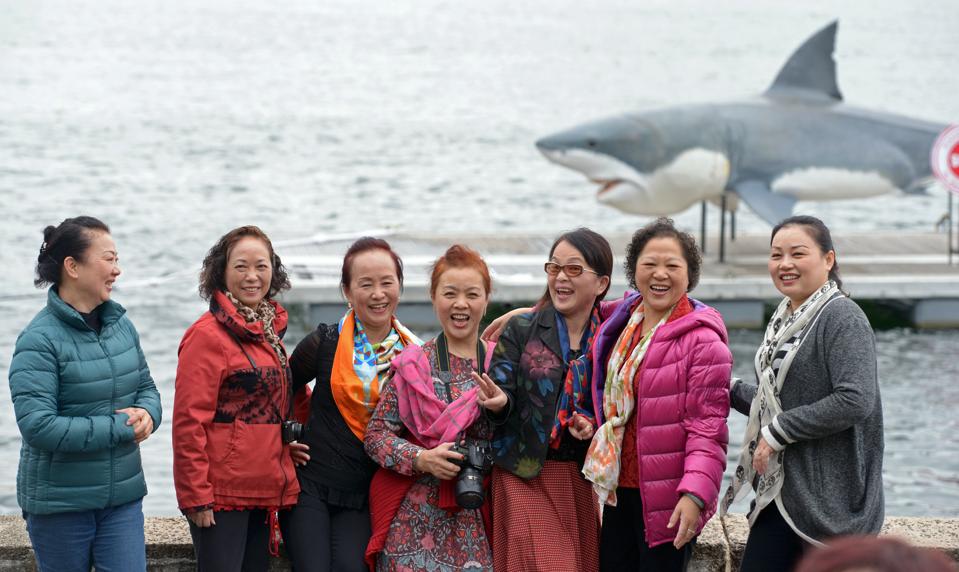
That’s because Chinese consumers collectively spent nearly $258 billion on international travel last year. That’s more than twice the combined amount spent on international travel by people from the United States and Germany, the next two biggest-spending nations, combined. And the Chinese are relative newcomers when it comes to venturing beyond their nation’s borders. A smallish percentage of them travel outside of China each year, though given the size of that nation’s population even that small percentage represents well over 100 million Chinese travelers to foreign destinations.
Yet Chinese citizens flew, on average, just 65 miles last year vs. the 227 miles flown on average by U.S. residents, the 285 miles flown on average by Germans, the 271 miles flown on average by those from the United Kingdom, and the whopping 632 miles flown by the average Canadian last year.
That’s according to a recent report issued by GetGoing Travel Insurance.
What China’s high total spending on international travel and its low average number of miles flown on international travel tells us is that while only a relatively small percentage of China’s residents actually do travel outside their homeland, those who do spend a lot of money and don’t tend to go all that far. China is home to approximately 1.4 billion people, making it the most populous nation on Earth. But the low average of miles travel on international trips is the function of two factors:
· A relatively small percentage of Chinese now have the financial ability to travel internationally, though the numbers who do travel outside of China are growing rapidly every year.
· A relatively large percentage of Chinese travelers beyond their nation’s borders stay relatively close to home. In fact, a big share of them go to Hong Kong, Macau and Taiwan. They go there either to visit friends and relatives who live in those places or to gamble in the casinos and or enjoy the entertainment venues in Macau and Hong Kong. Hong Kong attracted 44.5 million Chinese visitors, Macau 17.2 million and Taiwan 10.7 million.
Those numbers imply strongly that as more and more Chinese attain middle class status and the financial ability to travel internationally, and as Chinese become more and more interested in traveling visiting destinations farther and farther away from home their spending on international travel and the average distances flown will both rise exponentially.
Americans last year collectively spent about $135 billion on foreign travel according to the GetGoing report, for second place on the top 10 list of foreign travel spending. Germany ranked third at $89.1 billion. The rest of the top 10 include: the United Kingdom ($171.4 billion); France ($41.4 billion); Canada ($31.8 billion); South Korea ($30.6 billion); Italy ($27.7 billion); Australia $34.2 billion; and Russia ($31.1 billion).
Like China, South Korean’s average number of miles flown internationally is noticeably low. Right now that’s mostly because South Koreans’ most common foreign destinations are Japan, China, Thailand and the U.S. But as more South Koreans are able to afford international travel – as expected, given the strength of that nation’s economy – and as they become open to venturing further away from home and to less obvious destinations, they too, like the Chinese are likely to see a large increase in combined foreign travel spending and international miles flown.




 Around The World Travel